Showing posts with label Productivity. Show all posts

Mental Models

There is a specific kind of silence that only exists at 3:00 AM on a muddy trail in the middle of a race. Your headlamp is failing, your quads feel like they've been tenderized by a mallet, and your brain is screaming—rationally, logically—that you should stop.

Over the years, I've realized that the "algorithms" I learned in ITB and the "frameworks" I mastered in KAIST MBA are exactly what keep me moving on the trail. And conversely, the "grit" of the trail is what allows me to lead Suitmedia through the volatility of the Indonesian tech landscape.

Success is isomorphic. The same principles that scale a company win a mountain race. These are the mental models I live by, grouped into the pillars that define my world.


BTS Ultra 2025


I. How I Think

These are the foundational models for clarity. If my internal "Map" is wrong, no amount of speed will get me to the right destination.


1. The Logic of Truth

Before you can solve a problem, you have to see it clearly.

  • First Principles Thinking: Strip a problem to the core truths. Don't reason by analogy; build your own logic from the ground up.
  • Occam's Razor: When faced with two competing theories, the simplest one is usually the truth. Avoid over-engineering your life.
  • Map vs. Territory: Your mental models, plans, and spreadsheets are just "maps." Never confuse the abstraction with the messy reality of the "territory."
  • Circle of Competence: Be brutally honest about what you know and where your expertise ends. Play only in games where you have an edge.


2. Strategic Decision Making

Choosing the path when the fog of war (or mountain mist) is thick.

  • Inversion: Instead of asking how to succeed, ask "How could I spectacularly fail?" Then, build systems to avoid those specific pitfalls.
  • Probabilistic Thinking: Life is a game of odds, not certainties. Focus on making high-probability bets rather than chasing sure things.
  • Regret Minimization: When at a crossroads, choose the path that your 80-year-old self would be most proud of.
  • Sunk Cost Fallacy: Having the courage to walk away from a bad project or relationship, regardless of how much time or money you've already invested.


3. The Physics of Growth

How to ensure effort results in exponential progress.

  • The Pareto Principle: Identify the 20% of inputs—habits, clients, or training—that produce 80% of your results. Ruthlessly cut the rest.
  • Compounding: The most powerful force in the universe. Tiny, 1% gains repeated over a decade create exponential wealth, wisdom, and fitness.
  • Velocity vs. Speed: Speed is how fast you move; Velocity is speed plus direction. It's better to crawl toward the right goal than sprint toward the wrong one.
  • Theory of Constraints: Every system has one primary bottleneck. Improving anything else is an exercise in futility. Find the bottleneck; widen it.


4. Human & Social Dynamics

Navigating the "Human API" in leadership and life.

  • Incentives: Show me the incentive, and I will show you the outcome. If you want to change behavior, change the reward structure.
  • Hanlon's Razor: Never attribute to malice what can be adequately explained by neglect or a simple mistake. It saves a lot of unnecessary anger.
  • Social Proof: We are biologically wired to mimic others. Use this awareness to choose mentors wisely and avoid groupthink traps.
  • Pygmalion Effect: People generally live up to or down to the expectations we set for them. Lead with high belief in your team.


5. Systemic Resilience

Building a person in me that gets stronger under pressure.

  • Antifragility: Designing your life so that you don't just survive the storm—you actually get stronger because of them.
  • Feedback Loops: The shorter the gap between an action and its feedback, the faster you can iterate and improve.
  • Margin of Safety: Always leave a buffer—in your schedule, your bank account, and your heart rate—for the unknown unknowns.
  • The Power of Narrative: The stories we tell ourselves about our failures determine whether they become traumas or fuel for growth.

Sipping Coffee, Sharing Wisdom

Since early 2023, I've been conducting CTO-Intern catchup sessions where I meet with new interns in batches over coffee to get to know them individually. During these sessions, I typically inquire about their backgrounds, motivations, and hobbies. Towards the end of the catchup, I allow them to ask me anything, with each person having the opportunity to pose one question. Thus far, I've noticed many recurring questions, which I'll summarize in this post for future reference. 😁


CTO-Intern Catchup - Malang, Nov 2023


1. What's the biggest lesson you've learned in your career so far?

The most significant lesson I've learned in my career is the importance of adaptability and growth mindset. The business landscape is constantly evolving, and being able to adapt to change quickly and effectively is crucial for success. Growth mindset has enabled me to embrace challenges as opportunities for growth, view failures as learning experiences, and persist in the face of setbacks.


Source: Deepstash


2. How do you prioritize tasks and manage your time effectively?

Prioritizing tasks and managing time effectively is essential, particularly in a fast-paced environment like ours. I rely on planning, delegation, and time management techniques to stay organized and focused. This includes setting clear goals and priorities, breaking down larger tasks into smaller, manageable steps, and utilizing tools like Google Calendar and Google Tasks to track progress and deadlines. Additionally, I prioritize tasks based on their impact and urgency, focusing on those that will have the greatest positive outcome for the company.


Read: Efficient Productivity Matrix


3. What qualities do you look for in potential future leaders?

When identifying potential future leaders, I seek a combination of strong interpersonal skills, strategic thinking, and a growth mindset. Effective leaders not only inspire and motivate others but also possess the vision and strategic acumen to propel the company forward. They should demonstrate a willingness to continuously learn and grow, as well as the ability to navigate ambiguity and lead through uncertainty.


Source: LifeHack

Work From Anywhere

Sudah lebih dari 2 tahun Suitmedia bekerja secara remote atau bekerja secara WFA (Work From Anywhere), di mana setiap karyawan boleh memilih untuk bekerja dari kantor atau dari rumah atau dari lokasi workcation masing-masing.


Awalnya kami memutuskan untuk bekerja dari rumah (WFH) sepenuhnya pada bulan Maret 2020 karena mau memitigasi risiko kesehatan sesuai arahan pemerintah di awal pandemi.


Namun setelah melewati masa adaptasi yang tidak mudah (mengubah kebiasaan WFO menjadi WFH tetapi tetap produktif dan efektif), akhirnya kami memutuskan untuk WFA secara permanen.


Berikut ini beberapa lessons learned dari pengalaman Suitmedia bekerja secara remote atau WFA selama lebih dari dua tahun, dan sebelumnya bekerja dengan sistem remote-friendly (boleh bekerja dari rumah seminggu sekali) selama lebih dari delapan tahun.


Source : Buffer


Manfaat WFA bagi karyawan

  • Efisiensi energi, waktu, dan biaya, karena tidak perlu commuting dari rumah ke kantor atau ke tempat klien.
  • Lebih banyak waktu dan perhatian untuk anak, keluarga, hobi, dan hal lain yang lebih penting dari pekerjaan.
  • Lebih bahagia, karena memungkinkan untuk workcation, bisa langsung refreshing setiap hari setelah selesai bekerja.
  • Terhindar dari COVID atau penyakit lainnya di tempat kerja atau di kendaraan umum saat commuting.


Manfaat WFA bagi perusahaan

  • Efektivitas tim meningkat, karena tidak ada waktu dan energi yang terbuang untuk commuting setiap hari kerja.
  • Akses talenta yang lebih luas, karena bisa merekrut SDM berkualitas tanpa batasan wilayah dan status sosial tertentu.
  • Efisiensi biaya sewa kantor, karena sebagian besar karyawan lebih merasa produktif bekerja dari rumah.
  • Mitigasi risiko kesehatan karyawan, jadi seandainya ada yang sakit tidak akan menular secara massal.

How to Get the Right Things Done

Peter F. Drucker was the inventor of "management by objectives" and has been described as the founder of modern management. He wrote some management books that I considered as must-read classics for all managers who want to get the right things done.


This blog post is my summary from "The Effective Executive", which was originally published in 1966, but still relevant to date.


To be effective is the job of the executive.

The executive is expected to get the right things done. Intelligence, imagination, and knowledge are essential resources, but only effectiveness converts them into results.


Photo by Brooke Lark


There are five practices that have to be acquired to be an effective executive:


#1 - Manage Your Time


Know where your time goes.

Do work systematically at managing the little of your time that can be brought under your control.


Start with finding out where your time actually goes.

Cut back unproductive demands on your time. Consolidate your discretionary time into the largest possible continuing units. Time is the limiting factor. The output limits of any process are set by the scarcest resource.


Identify and eliminate the things that need not be done at all.

Those are usually caused by lack of system (recurrent crisis), overstaffing, malorganization (excess of meetings), or malfunctioning information. Delegate activities that could be done by somebody else just as well, if not better. Eliminate the things that waste other people's time.


Control your time management perpetually.

Not only keep a continuing log and analyze it periodically, you should also set deadlines for the important activities, based on your judgment of your discretionary time.

11 Lessons Learned from "The 4-Hour Workweek"

"The 4-Hour Workweek" is the first Tim Ferriss' books that I read three years ago. This book has some good insights which I agree and some I disagree. Actually there are even more insights from Tim's other books such as "Tools of Titans" and "Tribe of Mentors". But here are some lessons I learned from T4HWW.


Chilling at Nusa Dua, Bali (March 2017)


#1 - Different is better when it is more effective or more fun.

If everyone is defining a problem or solving it one way and the results are subpar, this is the time to ask, What if I did the opposite? Don’t follow a model that doesn’t work. If the recipe sucks, it doesn’t matter how good a cook you are.


#2 - What you do is infinitely more important than how you do it.

Effectiveness is doing the things that get you closer to your goals. Efficiency is performing a given task (whether important or not) in the most economical manner possible. Doing something unimportant well does not make it important. Requiring a lot of time does not make a task important. Efficiency is still important, but it is useless unless applied to the right things.


#3 - Focus on being productive instead of busy.

Doing less meaningless work, so that you can focus on things of greater personal importance, is NOT laziness. Being busy is a form of laziness—lazy thinking and indiscriminate action. Being overwhelmed is often as unproductive as doing nothing, and is far more unpleasant. Being selective—doing less—is the path of the productive. Focus on the important few and ignore the rest. It’s easy to get caught in a flood of minutiae, and the key to not feeling rushed is remembering that lack of time is actually lack of priorities.

16 Lessons Learned from "ReWork"

"ReWork" is one of the most influential business books I ever read. In fact it was the first business book that I read when I joined Suitmedia in 2011. Although I don't agree with some points of views from the authors, this book gave me a lot of very good insights that are still relevant until now. This article is a collection of my favourite ideas from the book.

ReWork
“What you do is what matters, not what you think or say or plan.” ― Jason Fried, Rework

#1 - Learning from mistakes is overrated
What do you really learn from mistakes? You might learn what not to do again, but how valuable is that? You still don’t know what you should do next. Contrast that with learning from your successes. Success gives you real ammunition. When something succeeds, you know what worked—and you can do it again. And the next time, you’ll probably do it even better.

#2 - Scratch your own itch
The easiest, most straightforward way to create a great product or service is to make something you want to use. That lets you design what you know—and you’ll figure out immediately whether or not what you’re making is any good.

#3 - No time is no excuse
When you want something bad enough, you make the time—regardless of your other obligations. The truth is most people just don’t want it bad enough. Then they protect their ego with the excuse of time. Don’t let yourself off the hook with excuses. It’s entirely your responsibility to make your dreams come true.

#4 - Start a business, not a startup
A business without a path to profit isn’t a business, it’s a hobby. Actual businesses have to deal with actual things like bills and payroll. Actual businesses worry about profit from day one. Actual businesses don’t mask deep problems by saying, “It’s OK, we’re a startup.” Act like an actual business and you’ll have a much better shot at succeeding.

#5 - Building to flip is building to flop
You need a commitment strategy, not an exit strategy. You should be thinking about how to make your project grow and succeed, not how you’re going to jump ship. If your whole strategy is based on leaving, chances are you won’t get far in the first place.

Building a Small Business That Works

"The E-Myth" is a classic business book, originally written in 1986 by Michael Gerber. This book is about why most small businesses don't work and what to do about it. The author updated this book in 2004 as "The E-Myth Revisited". I read this book few years ago when I felt frustrated at work due to balancing my role as entrepreneur, manager, and technician. This book helped me figure out that frustration is common among business owners and how to overcome it.

My team at Suitmedia Jakarta

This blog post is my collection of favourite paragraphs from Michael Gerber's "The E-Myth" as my personal reminder. I will also add some other videos – not from The E-Myth – but still relevant to this concept.


The Entrepreneurial Myth
The myth that most people who start small businesses are entrepreneurs, while there is a fatal assumption that an individual who understands the technical work of a business can successfully run a business that does that technical work. The fact is that most small business are run by Technicians and that technical work of a business and a business that does that technical work are two totally different things.


The Entrepreneur, the Manager, and the Technician
Everybody who goes into business is actually three-people-in-one: The Entrepreneur, The Manager, and The Technician.
  1. The Entrepreneur is our creative personality—always at its best dealing with the unknown, prodding the future, creating probabilities out of possibilities, engineering chaos into harmony.
  2. The managerial personality is pragmatic. Without The Manager there would be no planning, no order, no predictability.
  3. The Technician is the doer. “If you want it done right, do it yourself” is The Technician’s credo.


How to Be an Effective Person

"The 7 Habits of Highly Effective People" is a classic self-help book that I read for the first time when I was a high-school student. Back then, I just read it without fully understanding the context of Stephen Covey's principles. I still remember all those seven habits, but didn't realize how to apply it optimally in the real world until I re-read this book again recently.

This blog post is my collection of paragraphs from Stephen Covey's "The 7 Habits" as a reminder. I also add some other insightful talks that I learned in my life, which also related to these seven principles.


THE 7 HABITS OF HIGHLY EFFECTIVE PEOPLE


The P/PC Balance – P stands for production of desired results, the golden eggs. PC stands for production capability, the ability or asset that produces the golden eggs.


Always treat your employees exactly as you want them to treat your best customers. When people fail to respect the P/PC Balance in their use of physical assets in organizations, they decrease organizational effectiveness and often leave others with dying geese. There are organizations that talk a lot about the customer and then completely neglect the people that deal with the customer — the employees.

You can buy a person’s hand, but you can’t buy his heart. His heart is where his enthusiasm, his loyalty is. You can buy his back, but you can’t buy his brain. That’s where his creativity is, his ingenuity, his resourcefulness. PC work is treating employees as volunteers just as you treat customers as volunteers, because that’s what they are. They volunteer the best part — their hearts and minds.


Effectiveness lies in the balance. Excessive focus on P results in ruined health, worn-out machines, depleted bank accounts, and broken relationships. Too much focus on PC is like a person who runs three or four hours a day, bragging about the extra ten years of life it creates, unaware he’s spending them running.

#1 - Be Proactive

Principles of Personal Vision


Reactive vs. Proactive – Reactive people are often affected by their physical environment. If the weather is good, they feel good. If it isn’t, it affects their attitude and their performance. Proactive people can carry their own weather with them. Whether it rains or shines makes no difference to them. They are value driven; and if their value is to produce good quality work, it isn’t a function of whether the weather is conducive to it or not.

It’s not what happens to us, but our response to what happens to us that hurts us. Proactive people are still influenced by external stimuli, whether physical, social, or psychological. But their response to the stimuli, conscious or unconscious, is a value-based choice or response.


Listen to your language and to the language of the people around you. Our language is a very real indicator of the degree to which we see ourselves as proactive people.

Reactive Language vs. Proactive Language

Review the situation in the context of your Circle of Influence. Proactive people focus their efforts in the Circle of Influence. They work on the things they can do something about. The nature of their energy is positive, enlarging and magnifying, causing their Circle of Influence to increase.

Reactive people, on the other hand, focus their efforts in the Circle of Concern. They focus on the weakness of other people, the problems in the environment, and circumstances over which they have no control. The negative energy generated by that focus, combined with neglect in areas they could do something about, causes their Circle of Influence to shrink.

Source: thensomehow.com

The problems we face fall in one of three areas: direct control (problems involving our own behavior); indirect control (problems involving other people’s behavior); or no control (problems we can do nothing about, such as our past or situational realities). The proactive approach puts the first step in the solution of all three kinds of problems within our present Circle of Influence.


Answering 11 Questions from Tim Ferriss' Tribe of Mentors

I read "Tribe of Mentors" book by Tim Ferriss two years ago and I found it's interesting because you can extract unique insights from various succesful people by giving them the same questions.

And I wonder if the same eleven questions were thrown at me, what my answers would be. It's also a good exercise to understand the weight of each question before I try to adapt this style of interview to numerous successful friends of mine. So here they are..

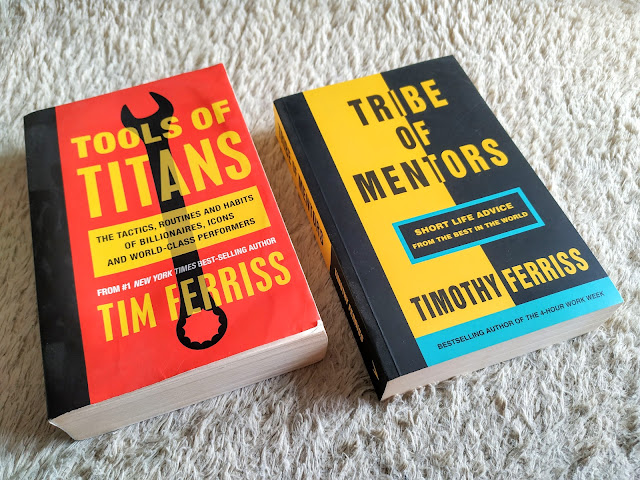
"Tools of Titans" and "Tribe of Mentors" by Tim Ferriss

1. What are one to three books that have greatly influenced your life?

Almost all books that I read are non-fiction which around personal development, psychology, business, and economic books. So I have two categories of books that influenced me.

For my personal life:
  1. "The 7 Habits of Highly Effective People" by Stephen Covey
    → Summary: How to Be an Effective Person
  2. "How To Win Friends and Influence People" by Dale Carnegie
    → Summary: Mastering Interpersonal Skills
  3. "Atomic Habits" by James Clear
    → Summary: How to Build Good Habits & Break Bad Ones

For my professional life:
  1. "The E-Myth Revisited" by Michael E. Gerber
    → Summary: Building a Small Business That Works
  2. "Rework" by Jason Fried & DHH
    → Summary: 16 Lessons Learned from "ReWork"
  3. "The 4-Hour Workweek" by Tim Ferriss
    → Summary: 11 Lessons Learned from "The 4-Hour Workweek"

2. What purchase of $100 or less has most positively impacted your life in recent memory?

There were so many books that I need to read but I didn't have enough free time. So, I've subscribed Blinkist for $40 / year since two years ago and just read the book summaries first. If the summary was interesting, then I read the whole book. This way I can learn more things faster.

3. How has a failure set you up for later success?

I went to a mediocre high school in Bandung, and I felt it was a failure. However, it helps me build my mindset not to compare with others, but to compare with ourselves. We don't need to be better than others, we just need to be better than our previous self.

It Doesn't Have to Be Crazy at Work

After "Getting Real" (2006), "Rework" (2010), and "Remote" (2013), last year Jason Fried and David Heinemeier Hansson published new book titled "It Doesn't Have to Be Crazy at Work". Both authors are the co-founders of Basecamp, previously 37signals, and the creator of the infamous web application framework: Ruby on Rails. Like their all previous books, there are a lot of great insights about how to run a company from them, although I don't agree at some points. This post is the summary lesson learned of their last book, which contain practices that are very insightful and also good reminders for me to run Suitmedia as a calm profitable company.

It Doesn't Have to Be Crazy at Work

A company is like software. It has to be usable, it has to be useful. And it probably also has bugs, places where the company crashes because of bad organizational design or cultural oversights. When you start to think about your company as a product, all sorts of new possibilities for improvement emerge. When you realize the way you work is malleable, you can start molding something new, something better. Whether you own it, run it, or “just” work there, it takes everyone involved to make it better.

Curb Your Ambition

You can absolutely run a great business without a single "goal". You don’t need something fake to do something real. And if you must have a goal, how about just staying in business? Or serving your customers well? Or being a delightful place to work? Just because these goals are harder to quantify does not make them any less important.


Defend Your Time

Your time in the office feels shorter because it’s sliced up into a dozen smaller bits. Most people don’t actually have 8 hours a day to work, they have a couple of hours. The rest of the day is stolen from them by meetings, conference calls, and other distractions. So while you may be at the office for 8 hours, it feels more like just a few.


When you cut out what’s unnecessary, you’re left with what you need. And all you need is 8 hours a day for about 5 days a week. You can’t expect people to do great work if they don’t have a full day’s attention to devote to it. Partial attention is barely attention at all.


Effective > Productive. When people focus on productivity, they end up focusing on being busy. Filling every moment with something to do. And there’s always more to do! Being productive is about occupying your time—filling your schedule to the brim and getting as much done as you can. Being effective is about finding more of your time unoccupied and open for other things besides work. Time for leisure, time for family and friends. Or time for doing absolutely nothing.

Tips untuk Fresh Graduates

"The person passionate about what he or she is doing will outwork and outlast the guy motivated solely by making money." ― Reid Hoffman

Sejak tahun 2011 salah satu kegiatan yang saya lakukan hampir setiap minggu adalah melakukan rekrutmen pegawai baru. Dari sekitar 10 orang di tahun 2011, Suitmedia bertumbuh secara organik menjadi sekitar 120 orang di tahun 2019.


Sebelum kami memiliki tim HR, saya dan co-founder lainnya turun tangan langsung membuat iklan lowongan kerja, mempublikasikannya ke berbagai channel, melakukan seleksi CV, mengundang kandidat, sampai dengan menguji kemampuan teknis dan interview mereka. Setelah ada tim HR pun (sejak tahun 2013), masih ada beberapa hal yang saya turun tangan langsung, khususnya terkait kandidat yang akan sering berkomunikasi langsung dengan klien.


Dari pengalaman tersebut, sering kali saya menemukan fresh graduates yang clueless (tidak tahu apa-apa) tentang kehidupan setelah lulus kuliah. Ada yang tersirat tidak mengenali dirinya sendiri. Ada yang tidak bisa membuat CV dan cover letter yang baik, bahkan tidak punya netiket yang baik ketika menghubungi perusahaan melalui email. Dan terakhir, ada juga beberapa yang messed up ketika proses interview.


Berawal dari coret-coret di notes yang saya upload di Instagram Stories beberapa bulan lalu – yang ternyata mendapatkan sambutan positif – tulisan ini sengaja ditulis dalam bahasa Indonesia (mixed with English ala millennials) untuk membantu teman-teman fresh graduates dalam menghadapi tantangan dunia kerja.

Coret-coret sambil me-review CV, sambil menunggu klien

Tips #1 : Kenali Diri Sendiri

Tidak jarang saya menemukan kandidat yang tidak jelas dengan dirinya. Tersirat dari resume-nya, mereka banyak meluangkan waktu di bidang A, tapi kuliah di bidang B, lalu melamar kerja di bidang C, padahal punya potensi di bidang D. Oleh karena itu, hal pertama yang harus dilakukan oleh fresh graduates adalah kenali diri sendiri!

Carilah apa yang menjadi 'ikigai' dalam hidupmu. Ikigai lebih dari sekadar passion. Ikigai merupakan alasan mengapa kamu hidup dan bermanfaat (memberikan value) bagi orang-orang di sekitarmu. Ketika kamu sudah menemukan ikigai, hal ini akan menjadi salah satu energi pendorong ketika kamu bangun di pagi hari untuk segera berkarya.

Efficient Productivity Matrix

"The most urgent decisions are rarely the most important ones." — Dwight Eisenhower

Dwight David Eisenhower was the 34th President of the United States, serving two terms from 1953 to 1961. During his period of presidency, he started space exploration (NASA), created the Internet (DARPA), and built the Interstate Highway System. Previously, he was a five-star general in the US Army, served as the Supreme Commander of the Allied Forces in Europe during World War II. After war, he became President of Columbia University, and then served as first Supreme Commander of NATO. Due to his incredible ability to sustain productivity for years. many people study his productivity strategy. His most famous method is Eisenhower Matrix.


Einsenhower Matrix
It is a 2x2 matrix that helps us decide on and prioritize tasks by urgency and importance. Using the matrix below, we will separate our todo list based on four possibilities:
  1. Important and urgent (tasks to do first)
  2. Important, but not urgent (tasks to schedule)
  3. Urgent, but less important (tasks to delegate to someone else)
  4. Neither urgent nor important (tasks to eliminate)


The key of this matrix is differentiating between urgent and important. Urgent tasks require immediate attention, while important tasks contribute to our long-term mission, values, and goals. The objective of using Eisenhower matrix is to help us filter the noise from our decisions and concentrate on what really matters.

Quadrant #1 : Important and Urgent
Those are tasks that require our immediate attention and contribute to our long-term objectives. We should do it first in the morning. Examples:
  • Responding emails from top customers and top employees
  • Important deadlines that matter for our business or our careers
  • Emergency issues with health or family

Quadrant #2 : Important, not Urgent
Those are tasks that don't have a pressing deadline, but help us achieve our long-term objectives. We should schedule it or get those done in the afternoon to night. Examples:
  • Working on top priority projects
  • Annual / quarterly / monthly / weekly planning
  • Skills & knowledge improvement
  • Socializing : family time, volunteering
  • Quality me time : exercising, spending time with rewarding hobbies

Quadrant #3 : Urgent, but less Important
Those are tasks that require our immediate attention, but not really contribute to our life goals. Those are probably important for others, but not important for us. Mostly we need to delegate theme to someone else or just say no. If we decide to delegate them, we should keep track of delegated tasks by email, telephone or within a productive quick meeting to check back on their progress later. Examples:

Quadrant #4 : Neither Urgent nor Important
Those are just primarily distractions. We should eliminate them. Examples:
  • Watching useless TV programmes
  • Scrolling through social media

Now we can use this matrix for broad productivity plans ("How should I spend my time each week / month?") and for smaller / daily plans ("What should I do today?").


Efficient Productivity Matrix
This is from my real life experience. What if everything is already in Quadrant 1 & Quadrant 2? Which tasks should I do first in Quadrant 1 or Quadrant 2? In this case, Eisenhower matrix is not enough. We need to consider more than importance and urgency. We need not only being productive, but also being efficient. Effectiveness is doing the right things, while efficiency is doing things right.

To manage all my important tasks, I use an "efficient productivity matrix" which is a 3x3 box that helps me decide on and prioritize tasks by impacts and resources required.

Efficient Productivity Matrix : Top-left box is where "Work Smart" happens, while top-right is for "Work Hard"

Efficiency = Impacts / Resources
We need to realize that not all important tasks are worth the same. Some tasks are producing high impacts that could be higher monetary values or higher chance for us to successfully achieve our long-term missions, values, and goals. Meanwhile some other tasks are still important but producing less impacts.

In the other side, we also need to realize that we need different amount of resources to do each tasks. The resources could be our time, our efforts, our money, or our people. And if we think clearly, high-impact task doesn't always require high resources, vice versa. This is the key difference of work smart and work hard.

Work Smart, Work Hard
After we filter our todo list so that it contains only important tasks, we put each of them in one of the nine quadrants in 3x3 matrix above. Then, we should start working from the top-left box (tasks that produce high impacts but require less resources) toward to bottom-right box (tasks that produce low impacts but require high resources). Working smart means working on tasks on the top-left box and focusing our activities there. We should think hard to find what we can do with 20% of our resources that can create 80% of the impacts.

However, sometimes we find situations to choose between tasks with high impacts and high resources (box 2, 4, 7) and tasks with low impacts and low resources (box 3, 6, 8). Top-right is where working hard is necessary, giving the extra miles to achieve more than ordinary people.


Be Effective
Both Eisenhower matrix and efficient productivity matrix above help us to be more productive and efficient. However, the most important thing is we need to be effective. Peter Drucker in his book "Effective Executive" share how to be an effective leader, which I summarize in these three key points:
  1. Get the knowledge we need
    - What needs to be done?
    - What is the right to do?
  2. Plan and execute
    - Create action plans
    - Take responsibilities for decisions and communications
    - Focus on opportunities rather than solving problems
  3. Ensure everyone feel responsible and accountable

Good things come to those who work their asses off and never give up!

The Hard Thing About Hard Things

Ben Horowitz co-founded Opsware in 1999, which Hewlett-Packard acquired for $1.6 billion in cash in July 2007. Later, he and Marc Andreessen co-founded a venture capital firm Andreessen-Horowitz, which invests in several tech companies. While many people talk about how great it is to start a business, very few are honest about how difficult it is to run one. Ben Horowitz offers advice on building and running a startup through his book. This post is about my favorite parts from his book.

@bhorowitz's Tweet in May 2014 – best book party ever

The hard thing.
The hard thing isn’t setting a big, hairy, audacious goal. The hard thing is laying people off when you miss the big goal. The hard thing isn’t hiring great people. The hard thing is when those “great people” develop a sense of entitlement and start demanding unreasonable things. The hard thing isn’t setting up an organizational chart. The hard thing is getting people to communicate within the organization that you just designed. The hard thing isn’t dreaming big. The hard thing is waking up in the middle of the night in a cold sweat when the dream turns into a nightmare.

I will survive.
If you are going to eat shit, don’t nibble.

When things fall apart.
People always ask me, “What’s the secret to being a successful CEO?” Sadly, there is no secret, but if there is one skill that stands out, it’s the ability to focus and make the best move when there are no good moves. It’s the moments where you feel most like hiding or dying that you can make the biggest difference as a CEO.

Life is struggle.
Every great entrepreneur from Steve Jobs to Mark Zuckerberg went through the Struggle and struggle they did, so you are not alone. But that does not mean that you will make it. You may not make it. That is why it is the Struggle. The Struggle is where greatness comes from.

Zero To One

Peter Thiel is the co-founder of PayPal, early investor of Facebook, and co-founder of Founders Fund, which invests in several startups, including Palantir, SpaceX, Airbnb, and Spotify. In spring 2012 Peter taught Stanford class CS 183: Startup. Notes essays for the course, taken by student Blake Masters, led to a book titled Zero to One: Notes on Startups, or How to Build the Future, published in September 2014. This post is my favorite parts from the book – it could be a kind of summary.

The PayPal Mafia – Silicon Valley's richest group of men

The next Bill Gates will not build an operating system. The next Larry Page or Sergey Brin won’t make a search engine. And the next Mark Zuckerberg won’t create a social network. If you are copying these guys, you aren’t learning from them.

Today’s “best practices” lead to dead ends; the best paths are new and untried.

The Challenge of the Future
That is what a startup has to do: question received ideas and rethink business from scratch.

Party Like It's 1999
The entrepreneurs who stuck with Silicon Valley learned four big lessons from the dot-com crash that still guide business thinking today:
  1. Make incremental advances.
  2. Stay lean and flexible.
  3. Improve on the competition.
  4. Focus on product, not sales.

And yet the opposite principles are probably more correct:
  1. It is better to risk boldness than triviality.
  2. A bad plan is better than no plan.
  3. Competitive markets destroy profits.
  4. Sales matters just as much as product.

How much of what you know about business is shaped by mistaken reactions to past mistakes? The most contrarian thing of all is not to oppose the crowd but to think for yourself.

Business Model

A business model describes the rationale of how an organization creates, delivers, and captures value. In general, there are four main areas of business: customers, offers, infrastructure, and financial viability.

 Business Model Structure

Alexander Osterwalder and Yves Pigneur, authors of "Business Model Generation", described business model components very well into nine building blocks:
  1. Customer Segments
    - For whom are we creating value?
    - Who are our most important customers?
    - Mass, niche, segmented, diversified, or multi-sided markets?
  2. Value Propositions
    - What value do we deliver to the customer?
    - Which one of our customer’s problems are we helping to solve?
    - What bundles of products and services are we offering to each segment?
  3. Channels
    - Through which channels do our customers want to be reached?
    - How are we reaching them now?
    - How are we integrating them with consumer decision journey?
  4. Customer Relationships
    - What type of relationship does each of our customer expect us to establish and maintain with them?
    - How costly are they?

What Leads to Success?

Beberapa hari yang lalu saya menonton video TED Talk yang singkat tapi menarik dari Richard St. John. Dalam speech 3 menitnya di TED Conference, Richard St. John bercerita bahwa suatu saat ada seorang anak SMA yang duduk di sebelahnya di dalam pesawat terbang, bertanya kepadanya, apa sih yang membuat seseorang bisa menjadi sukses? What leads to success?

Bermula dari pertanyaan yang sulit dijawabnya waktu itu, Richard mulai mewawancarai lebih dari 500 orang sukses selama 10 tahun. Dan akhirnya, ada sebuah kesimpulan menarik yang diambil, bahwa ada 8 sikap penting untuk mencapai sukses: Passion, Work, Focus, Push, Ideas, Improve, Serve, Persist.

"8 To Be Great" by @RichardStJohn

Berdasarkan hasil riset Richard St. John, ada 8 faktor yang mempengaruhi kesuksesan, yaitu:
  1. Passion
    Carilah pekerjaan yang sesuai dengan gairah (passion) kita, maka uang pun akan mengikuti. Jangan berharap hal tersebut akan mudah dilakukan karena kita mungkin perlu mencoba banyak jenis pekerjaan sebelum kita menemukan pekerjaan apa yang benar-benar kita cintai.
  2. Work
    Bekerja dengan keras, bahkan dianggap workaholic, karena apa yang kita kerjakan itu menyenangkan.
  3. Focus
    Jadilah seseorang yang fokus mengejar tujuan dan kembangkan kemampuan untuk mengabaikan gangguan (distraction).
  4. Push
    Jangan merasa malu atau meragukan diri sendiri sehingga merusak tujuan kita. Selalu cari cara atau orang lain untuk mendorong kita ke arah menuju kesuksesan.
  5. Ideas
    Semua orang bisa memiliki ide yang kreatif. Pikirkanlah hal-hal yang bisa menyelesaikan masalah, lalu tuliskan.
  6. Improve
    Selalu mencari cara untuk meningkatkan diri. Jadilah yang terbaik atas apa yang kita kerjakan. Fokus pada kekuatan kita dan terus berlatih.
  7. Serve
    Kita harus bisa memberikan value pada orang lain, yaitu produk atau layanan yang orang lain butuhkan atau inginkan.
  8. Persist
    Jangan pernah menyerah. Jangan berharap pada hasil yang instan. Jadikanlah kegagalan sebagai anak tangga menuju kesuksesan. Bersiaplah untuk membuat beberapa kesalahan.
Semoga bisa menginspirasi kita semua :)


Personal Productivity Empowerment

Last month, I was invited by the HR department of my workplace to attend a series of seminars titled "Personal Productivity Empowerment." The series comprised three topics: interpersonal skills, time management, and creativity. Each topic was covered over the course of one workday. Yes, it did consume a considerable amount of my work time. However, despite ultimately leading to overtime hours to catch up on pending tasks, seminars like these are undoubtedly worthwhile as they offer fresh perspectives. In this brief write-up, I'll share some key points that still resonate with me from the seminar:


Day 1 - Winning with People

"Any dream I can achieve without the help of others is too small." - John C. Maxwell


Success = Knowledge + Selling Skills + People Skills + Proper Attitude

  • Knowledge: Specific knowledge about our field of work
  • Selling Skills: Ability to sell products/services/ideas to others
  • People Skills: Ability to interact with others
  • Proper Attitude: Professional attitude towards work